
The UK Government has announced the release date of the 2020 Budget, which promises a “decade of renewal” and a “new chapter for the economy.” (1) For the already fragile Early Years Sector, the Budget is the last chance for the Government to resolve the Early Years funding crisis and ensure childcare remains accessible for all. Should the Budget not address the current childcare “chapters,’” Yoopies UK forecasts that childcare will become an exclusive privilege for wealthier families and, as a result, severely limit social mobility.
Affordable Childcare: The Foundation of Society
In light of changes to the traditional family structure, with over 70% (2) of mothers in work, the Early Years Industry has become a pillar of modern-day society. Economic growth is underpinned by a reliable and affordable childcare sector, permitting parents to return to work and providing the next generation with essential life skills. Yet, while the need for childcare has risen, access to affordable childcare has declined. Nurseries and childminders are consistently pressured to raise their fees to keep up with the rising cost of living. As a result, the challenges families face to finance childcare costs are on the rise. In 2019, over a “quarter (27%) of parents” (3) found meeting childcare costs “difficult or very difficult.” (4) With fewer low-cost childcare options, it is the poorest families who are the hardest hit.
The Budget provides an opportunity for the Government to combat the current childcare crisis. However, the sector has yet to feature alongside Government priorities including “the environment, new hospitals, training of police officers, vocational education and increasing the National Living Wage.” (5)
Fewer But Pricier Childcare places
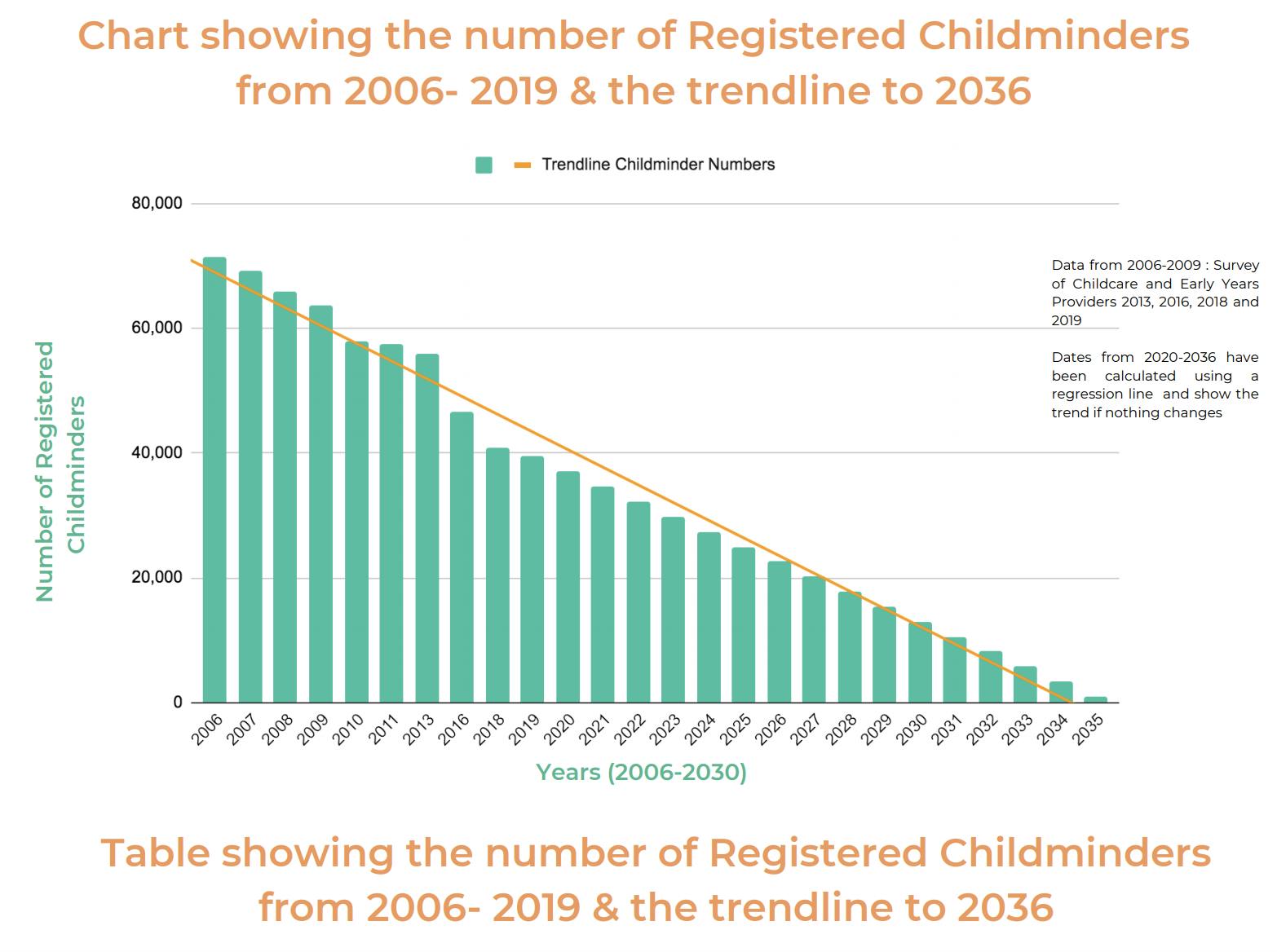
The upcoming Budget must address the alarming fall in childminder numbers to ensure the childcare industry provides a range of affordable childcare options for all families. Childminders are an essential part of the Early Years Sector offering a cheaper alternative to nurseries and flexible childcare hours. In recent years though, the total number of childminders has fallen to 39,400 in 2019, down from 40,900 in 2018 and 46,600 in 2016. (6) If this trend continues, Yoopies UK predicts childminding could be an extinct profession by as early as 2036.
Childminders have little support to balance the running of their own business and delivering the Early Years Curriculum. It therefore comes as little surprise that fewer childminders are joining the profession. Francesca Chong, UK Country Manager for Yoopies UK says “In 2018, the Government scrapped the Childcare Business Grant, the only funding scheme to help childminders start their business. In 2019 DfE proposed higher OFSTED fees. If 2020 fails to encourage childminder numbers, there will be a continued hike in price for fewer childcare places.” As demand increases and supply decreases with less Government intervention, childcare risks becoming a privilege for richer families rather than a right for all.
Funding Shortfall Hits Poorest Families Hardest
As well as supporting childminders, the Government must use the Budget to ensure that rising costs keep in line with the funding provided to other Early Years settings such as day nurseries. While many workers will welcome the 6% increase to the National Living Wage, for nurseries, introducing a higher living wage widens the gap between the cost of providing childcare and the actual funding that the nursery receives. Additional local authority funding confirmed by DfE in October 2019 is only 8p an hour for 2-year-old places, and up to 8p an hour for some 3-to-4-year-old places. (7) According to the Early Years Alliance, this represents an unproportionate funding increase of barely 2%. (8)
The gap between funding and cost of providing care has meant that ‘Free’ childcare hours are, in practice, far from free. Many nursery settings have had to find alternative ways to make up the cost difference. This includes charging parents additional fees, cutting back on resources or risk closing their doors altogether. Poorer families may not be able to fork out extra fees meaning nurseries in more deprived areas are more likely to suffer. Parents are then less able to return to work and educational opportunities for their children are restricted. Hence, raising the National Minimum Wage without proportional funding measures risks exacerbating a situation in which the poorest children are denied the same start in life as wealthier families. One parent told us, “I feel unable to commit to full-time work and afford childcare five days a week”
Ben Suchar, CEO of Yoopies UK concludes “The Government’s ‘decade of renewal’ (9) is dependent on accessible childcare. Without significant funding, the next ten years will see poor families remaining poor and a ‘chapter for the economy’ (10) that privileges the rich.”
Source 1: Gov.UK
Source 2: Gov.UK
Source 3: Survey of Childcare and Early Years Providers, 2019
Source 4: Survey of Childcare and Early Years Providers, 2019
Source 5: Gov.UK
Source 6: Survey of Childcare and Early Years Providers, 2016 and Survey of Childcare and Early Years Providers, 2019
Source 7: Early Years Funding 2020-21
Source 8: Early Years Alliance
Source 9: Gov.UK
Source 10: Gov.UK