

Contents:
1. About the survey
2. Which childcare providers have been able to work and what type of family are they working for?
3. Are families continuing to pay their childcare provider?
4. Are childcare providers receiving government support and which type of aid?
5. Childcare Provider Testimonies
6. Conclusion
Disclaimer: the use or publication of these figures must reference Yoopies UK with a link to this study.
1. About the survey:
We surveyed 425 childcare providers across the UK to understand how COVID-19 had affected their work and financial situation. Whilst admiration for frontline workers has swept the nation, our home heroes- the childcare sector- that have remained open for vulnerable children and keyworker children remain sidelined. The following statistics shed light on an alarming reality for the many forgotten workers of the childcare industry, the acts of solidarity that many childcare providers continue to show and the financial turmoil experienced by thousands.
Our study is an in-depth analysis of the childcare industry, including Ofsted registered Childminders, Ofsted registered Nannies, Non-Ofsted registered Nannies, CIW registered Childminders (Wales) and self-employed Babysitters. We explore the number of childcare providers that continue to work, the type of family requiring their services and the proportion of childcare providers that are able to access financial support from either the Government or families worked for.
This study brings to light the crippling financial reality for both childcare providers that are able to work and childcare providers who are currently not working. Financial fear, health concerns, and Government neglect have become their alarming reality.
2. We asked 425 childcare providers if they had had the opportunity to work during the COVID-19 Crisis:
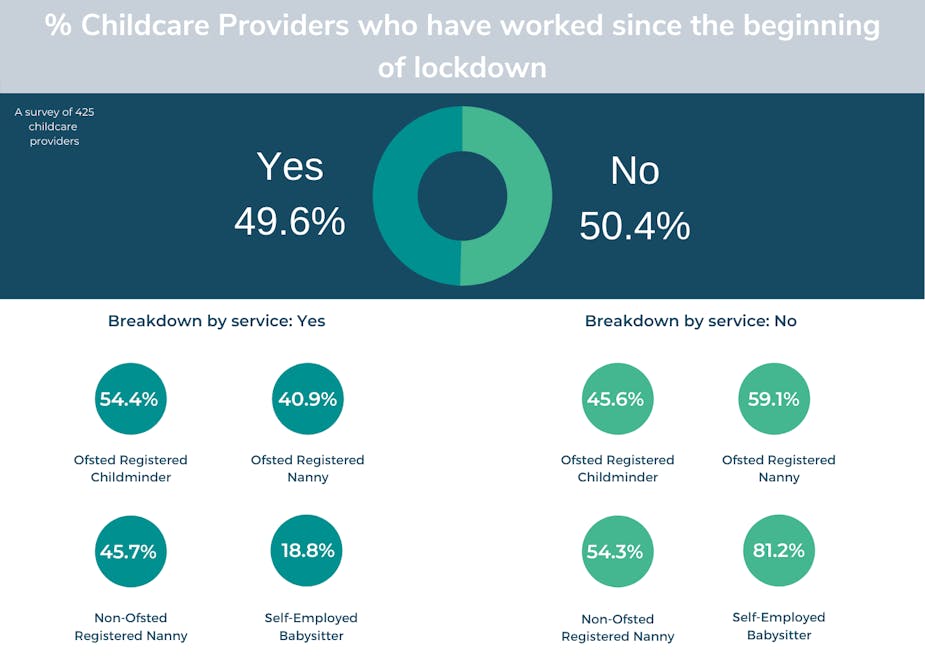
- Just under half of childcare providers have worked at some point during the COVID-19 Crisis
- Ofsted Registered Childminders were the only childcare provider group of which more than half had worked during the crisis. This is because Childminders and Nurseries alike were asked to remain open for Key-worker and vulnerable children.
- Most Self-Employed Babysitters have not worked, suggesting that most families have been respecting social distancing and only using childcare when absolutely necessary.
- Just under half of Ofsted Registered and Non-Ofsted Registered Nannies have worked, the figure remains high as it also includes live-in nannies.
2b. Of the childcare providers able to work, which type of family were they working for?
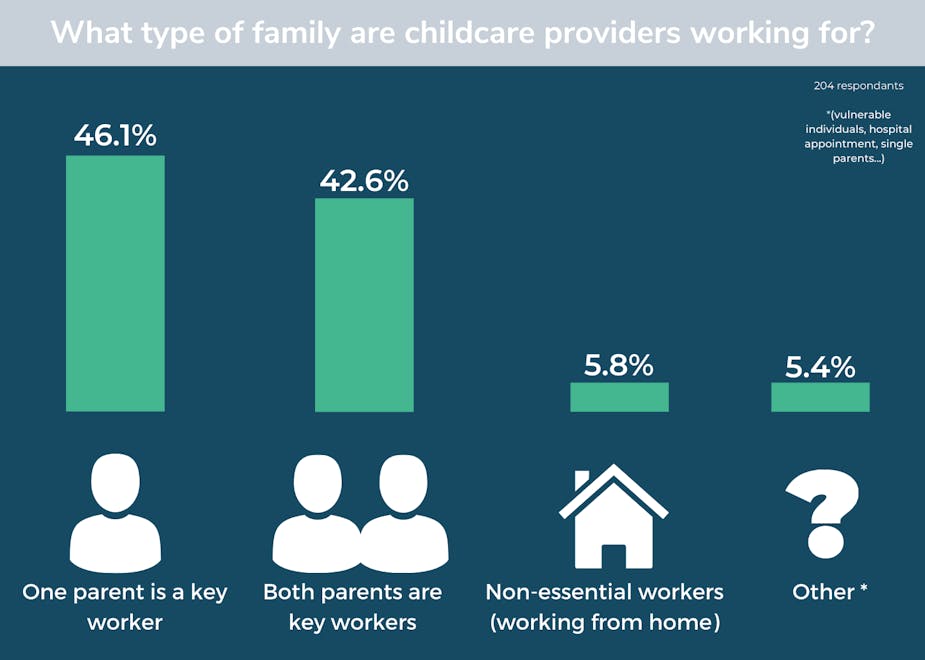
- Most childcare providers are working for families with key-worker parents, suggesting the majority of families are using childcare for emergency childcare only.
- A small percentage of childcare providers have been pressured into working for families where neither parent is a key-worker, in which many providers have said that they feel like they have no other choice but to do this
3a. Are families continuing to pay their childcare provider?
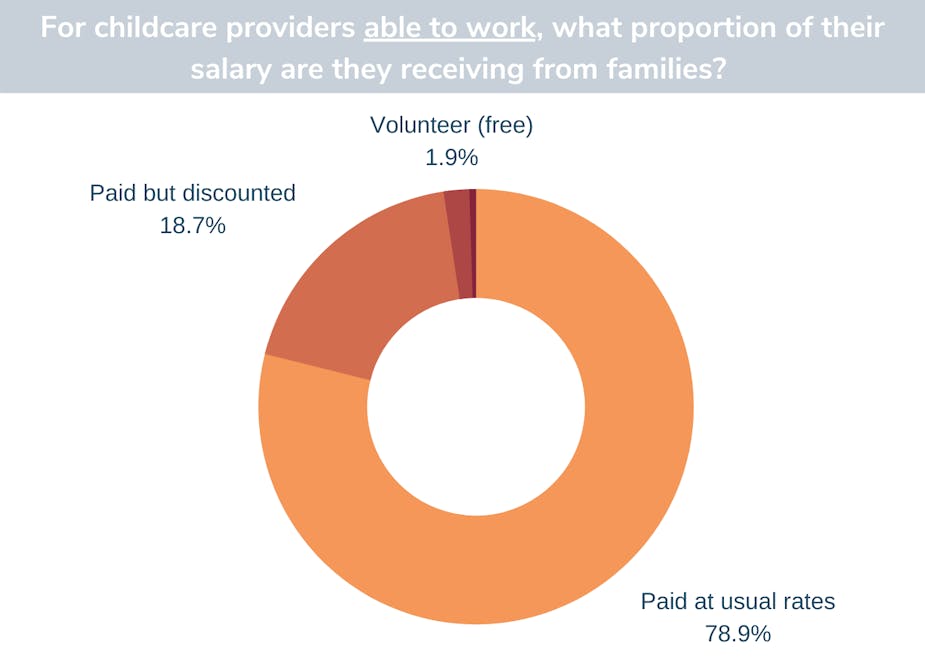
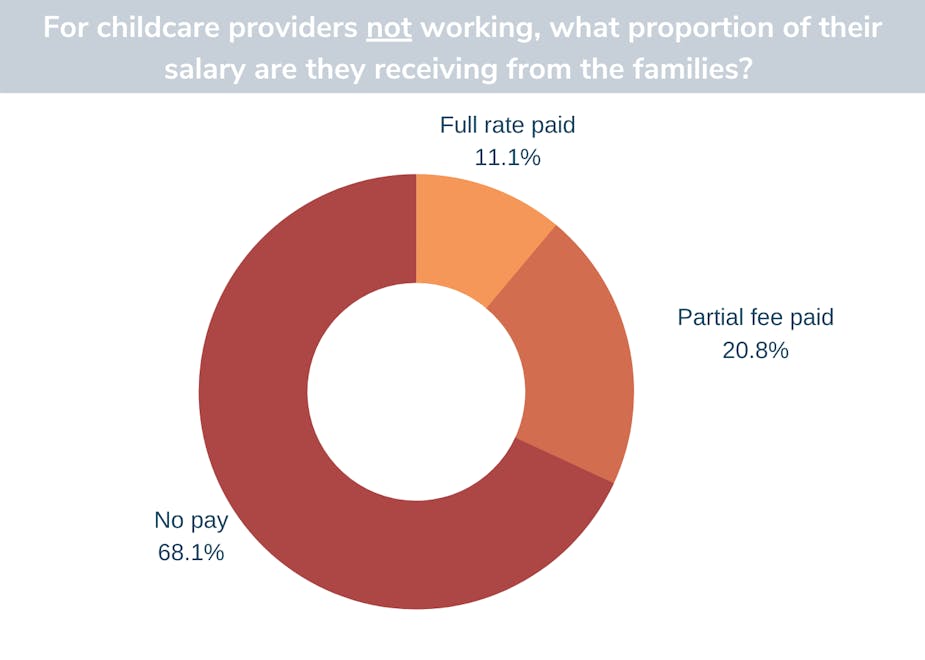
- Over half of families that employ childcare providers are not paying their providers when they are unable to work. From testimonies, childcare providers have said families assume that Government funding is enough and therefore do not pay them. In reality, many childcare providers are unable to access funding and those that can receive an inaccurate reflection of their wages as the scheme ignores high business costs, sidelines this year’s tax return and is based on net profit.
- Just over 30% of families are continuing to pay their childcare provider either their full rate or partial rate when they are unable to work. Testimonies outline cases in which childcare providers have had to ask their families to continue paying them out of goodwill to simply get by. Some testimonies tell of parents who are expecting these hours to be made up in lieu after the lockdown measures have been lifted.
- Nearly 80% of families are paying their childcare provider their full rate if they are able to work
- In the case where a childcare provider is able to work, just over 1/5 of families are paying their childcare provider a part of their salary. Testimonies highlight a situation in which childcare providers are charging a reduced rate to NHS and essential workers out of solidarity.
- In the case where a childcare provider is unable to work, just under 1/5 of families are paying their childcare provider a part of their salary.
3b. Are different childcare providers receiving different financial support from families?
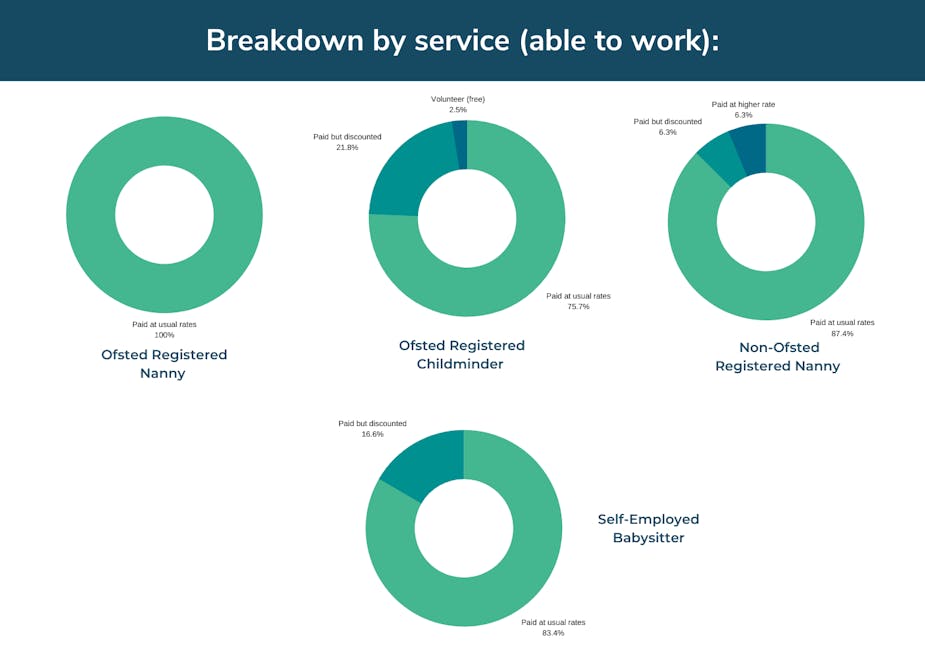
- Ofsted Registered Childminders that have been able to work are the least likely group to be paid their full rate and are the only group to evidence working on a free basis for families. Nearly 1/4 of childminders have worked on either a partial pay or voluntary basis
- Most Non-Ofsted Registered Nannies that have been able to work received their full rate and were the only group to evidence staff working at a higher rate. This could be to incentivise nannies to work in a situation where they might have normally been respecting social distancing.
- 100% of Ofsted Registered Nannies that are able to work were paid at their full rate and only 6% of Non-Ofsted Registered Nannies were paid a partial fee, the remaining 94% worked at their full rate or a higher fee. Childminders had over 3x more families paying a partial rate than Non-Ofsted Registered Nannies.
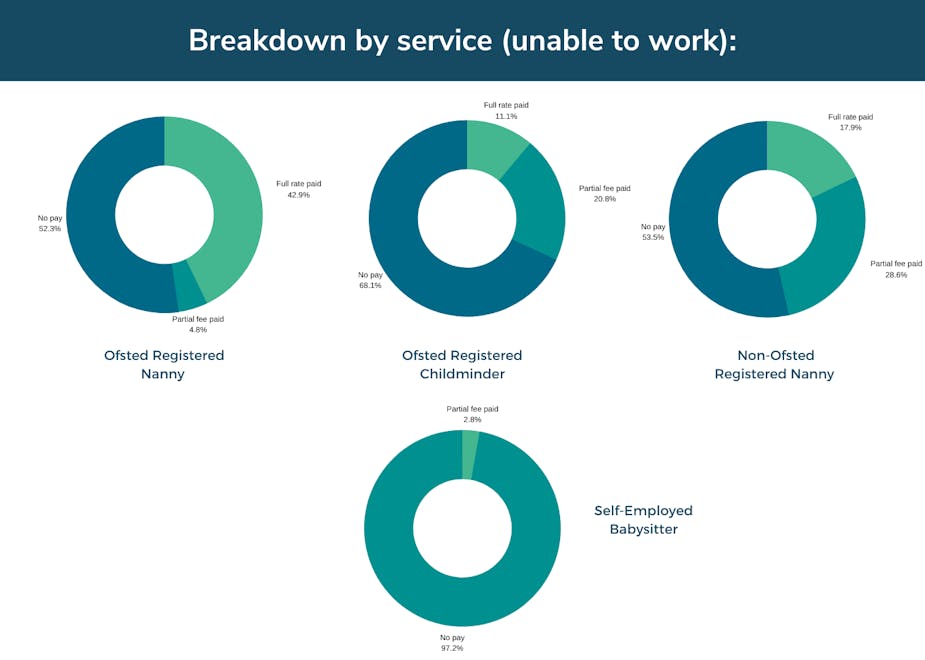
- Babysitters are the most likely category not to get paid by families, which is understandable given the nature of babysitting jobs and Government advice to stay at home.
- Ofsted Registered childminders are the second most likely category not to be paid by families. Nearly 70% of childminders are receiving no pay whereas just over 50% of Ofsted and Non-Ofsted Registered Nannies are receiving no pay. This is one of the many reasons childminders are particularly struggling.
- There is a large disparity between Non-Ofsted Registered and Ofsted Registered Nannies. Just over 40% of Ofsted Registered Nannies who are unable to work receive their full pay, whereas less than 20% of Non-Ofsted Registered Nannies who are unable to work receive their full pay.
4. Are childcare providers receiving government support and which type of aid?
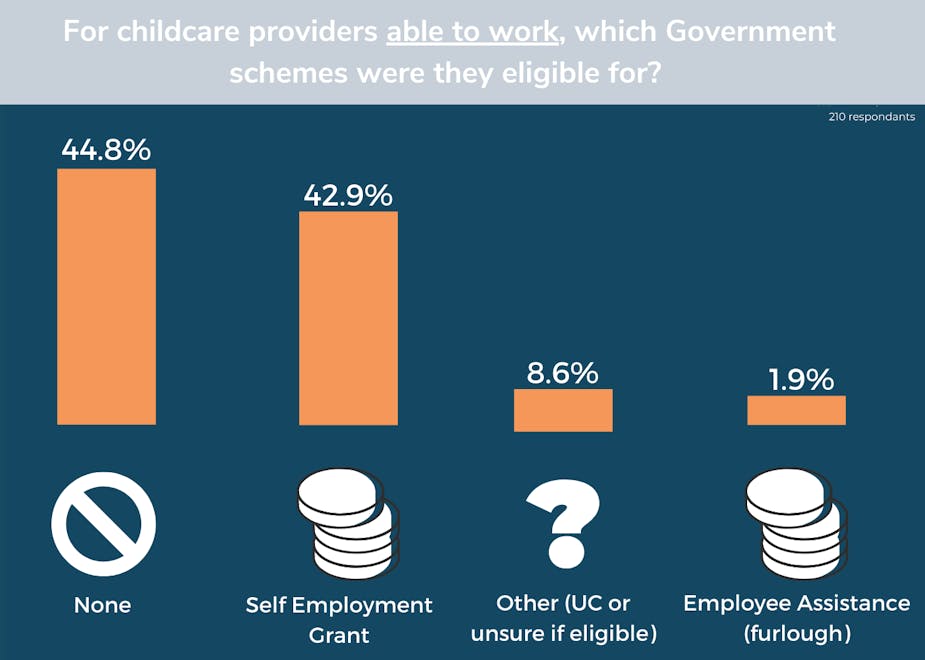
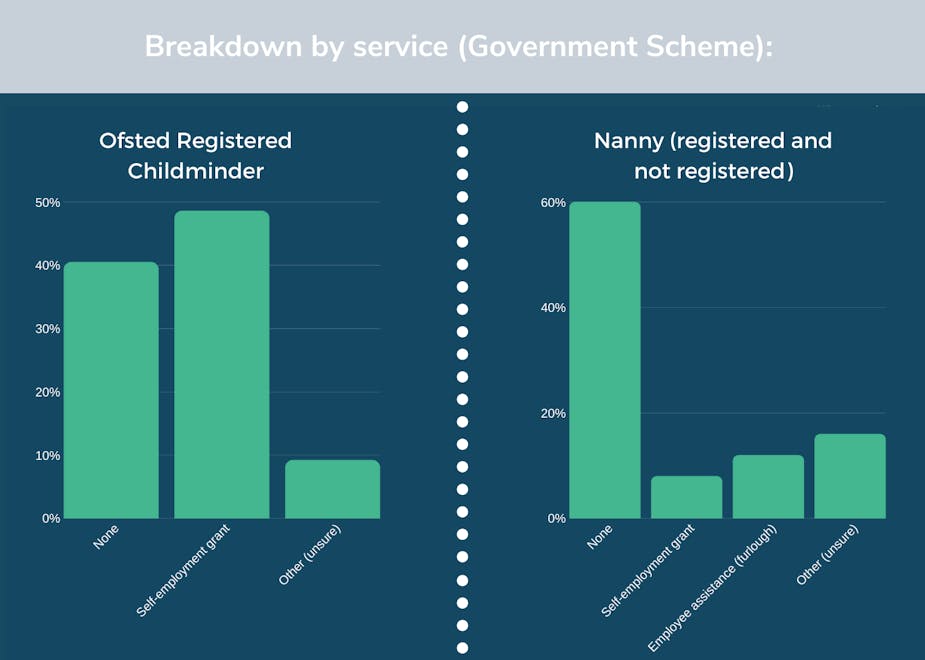
- Over half of working childcare providers are unable to apply for Government assistance. This includes childcare providers who have worked at reduced hours and reduced wages.
- For childcare providers that have been able to work, 41.7% are unable to apply for Government funding. This can be attributed to a number of reasons including running a childminder business that is less than one year, having a partner who earns more than the Universal Credit threshold, working for a family that refuses to furlough (nannies).
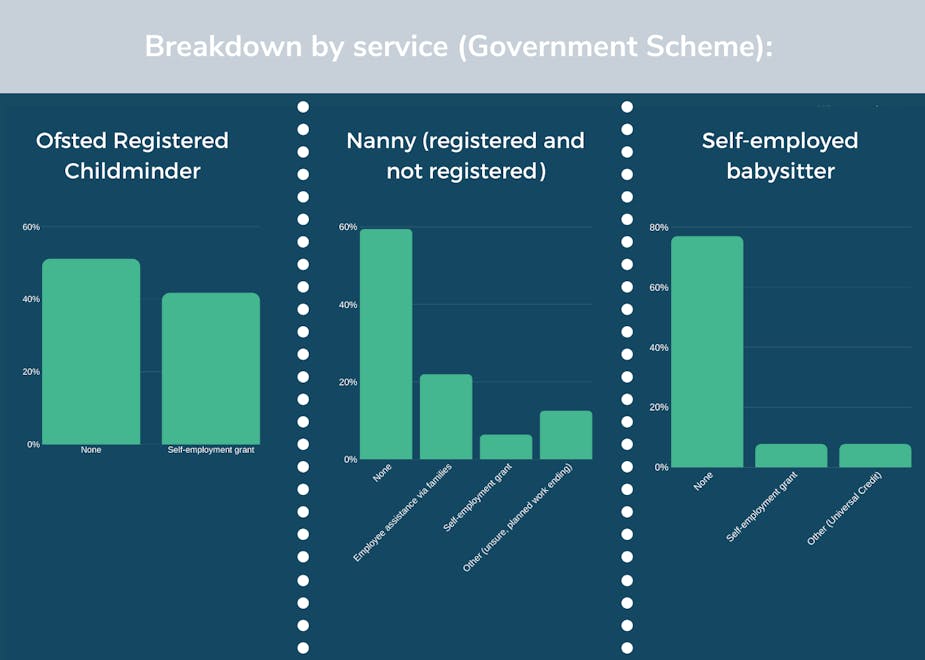
- 60% of working Nannies (both registered and non-registered) were not eligible for Government funding. This can be partially explained by the fact that live-in nannies continue to work normal hours, and that nannies would generally rely on the families to apply for the job retention scheme on their behalf which some may be unwilling to do.
- Most childcare providers are not eligible for Universal Credit, despite the Government reassuring the sector they could rely on this should they not have access to the other funding schemes available.
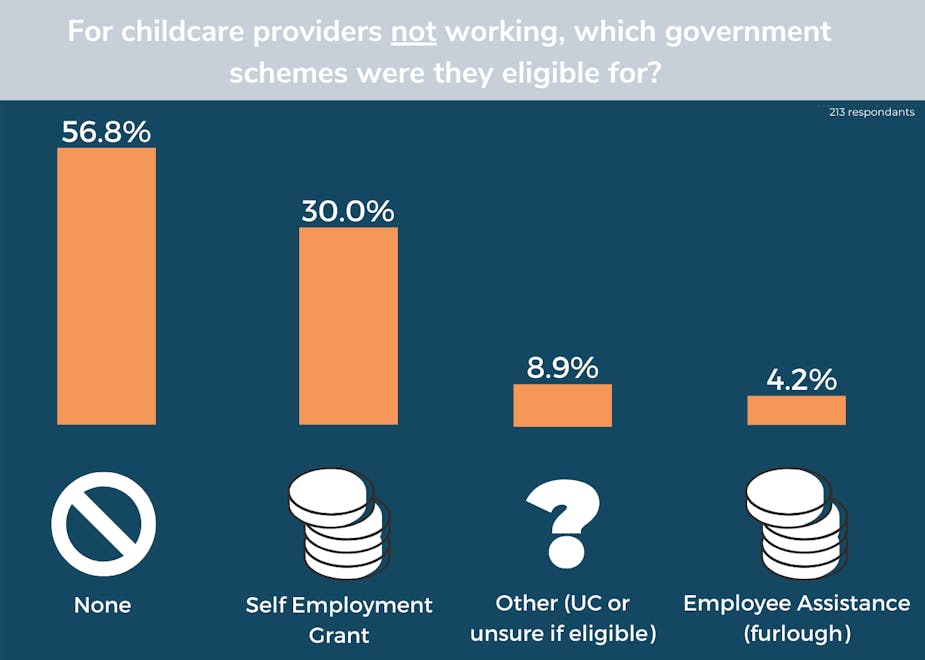
- Over half (56%) of childcare providers unable to work receive no support from the Government. This figure is higher than the childcare providers who are have been able to work.
- Childcare providers that are not working, such as childminders, are the hardest hit. Only 30% of childcare providers unable to work have been able to access the Self-Employment Grant, whereas 42.9% have of childminders able to work have access to the Self-Employment Grant.
- Most childcare providers are not eligible for Universal Credit, despite the Government reassuring the sector they could rely on this should they not have access to the other funding schemes available.
- Just over 1/5 of families have furloughed their Nanny when they are unable to work.
5. Testimonies
- Childminder: “I live and work with my daughter- we are both childminders. Our joint income has fallen from £3800 a month to £400. We are living off of my savings, which hopefully will last until the self-employed grant arrives. 2 parents have said they won’t return as I asked for 20% of their monthly fee as a retainer.”
- Childminder: “I am struggling with controlling depression and anxiety which in turn affects other health issues which affect my children and family”
- Childminder: “I have not been able to work since being told to close as no key workers to work for.”
- Childminder: “It’s very hard to bring a child into your home who might be spreading the virus as you can’t deep clean everyday put yourself & your family at risk but knowing you need to do your bit but for £4 an hour speaks volumes.”
- Childminder: “Childminders have always been at the bottom of the pile and unfortunately always will be”
- Childminder: “I am 51 and my husband 52 and we aren’t fit, but we are well, but still, being older is worrying. I have felt compelled to do so to support the NHS.”
- Childminder: “Putting our family in danger with COVID 19 by bringing in keyworker children, the husband is high risk but need to work to be paid”
- Childminder: “It’s been very hard especially when grant from the government will not be available until June”
- Childminder: “I could have continued to work for 1 of my families who’s parents are both essential workers offering wrap-around care before and after school. However, I made the choice to close as my own daughter is high risk and needed shielding. Being new to childminding one I g only in January I’m entitled to no support and will stay closed for at least 12 weeks to shield my daughter.”
- Childminder: “Worrying if I am doing the right thing for my family”
- Childminder: “It is a worrying experience as we are opening our homes to essential families while putting our lives and families at risk. We do it because it is important to support the children that come into our settings.
- Childminder: “Local authority and insurance companies were not very supportive of our individual needs and we became a forgotten workforce and not valued.”
- Childminder: “Horrible, scary I’m putting my family at risk, to help NHS staff save lives, I feel it’s my duty to do this but do feel very vulnerable.”
- Childminder: “I have nothing coming in and have had like many others had to cancel payments including my pension to be able to meet other bills from savings.”
- Childminder: “I have to manage and hopefully get the 80% self employment money which is not till the end of June. I also have to pay my assistant furlough wages and won’t get that back until sometime in May.”
- Childminder “Looking after NHS staff children with no extra funding for £3.85 per hour and having to use funding from a child who isn’t a key worker child to cover costs”
- Childminder: “The money we’re supposed to be receiving isn’t until June!! What am I supposed to do until then!!!”
- Childminder: “I had no choice but to open for keyworker families.”
- Childminder: “Until 2018/19 financial year my wife was working part-time so earned pittance in relation to this year and last. Due to this, the financial help the government will give will end up also being pittance. As we work together, childminding is our sole income and we are currently £2000 down on our usual monthly earnings. We have put our mortgage on hold for 3 months and personal loan on hold for 2 months but once these holiday periods come to an end we will basically have to choose between paying these 2 bills or buying food. If we aren’t given any proper financial help from the government during this period then we will come out of this with big debts and be extremely financially unstable. It is an extremely worrying time for us.
- Childminder: “Working for key worker parents I feel sometimes we are overlooked and not thought about”
- Childminder: “Feeling very undervalued, we welcome families into our home putting our own families at risk with no protection or acknowledgment, even though we go through the same grading and inspections as schools and nurseries.”
- Childminder: “Don’t know until June if we ll get the 80per cent for self-employed so hard to know if we should invoice parents even if their kids not coming.”
- Childminder: “Household bills still need to be paid so I’m very lucky that some of my parents (those who can) have been able to pay half fees to keep my business running as this still incurs costs despite only being open for keyworker children. However, it doesn’t account for the shortfall in my earnings and I still have my own family to provide for. On top of this, I am opening my doors for 40 hours a week to work for one keyworker family so increasing the risk to my own children and my partner and I.”
- Childminder: “I think childminders are putting themselves at risk by allowing key workers children into there homes allowing their parents to do a vital job, but we are the forgotten key workers.
- Childminder: “Had the majority of our income taken away from us and have to rely on the goodwill of others to survive until June to find out if we get anything from the government.”
- Childminder: “While media is all about NHS staff or how difficult it is to fill your time we are working full time and being paid less than normal! While newspapers such as the telegraph undermine us suggesting we are a less professional form of childcare!”
- Childminder: “On some days my net earnings are less than £1.70 per hour, and this includes the early starts and late finishes. We are a forgotten workforce.”
- Childminder: “I am working, I won’t be eligible for the self-employed grant as my earnings will counteract the amount I would get. I’m working because if I don’t, I know the NHS staff will have to stop working to care for the children, but I also care for vulnerable children who would not be safe to be at home for 12 weeks. I am putting my family at risk and essentially not making any more money than if I closed and took the grant but I know the work I am doing is 100% needed by the families I have.”
Nannies
- Nanny: “Guidelines are not clear enough for nannies”
- Nanny: “My family furloughed me but still expect me to do online tutoring for them”
- Nanny: “According to the new guidelines, nannies can go back to work but shouldn’t be working if at least one parent is at home. Everyone is working from home now though, so how can we go back to work? So many contradictions.”
- Nanny” Since COVID-19, I moved in with the family to do a live-in Nanny position”
- Nanny: It is frustrating that families can furlough and then employ another nanny when they are not key workers and both work from home – clearly a loophole.
- Nanny: “It’s frustrating that I can go to work to mix a household but I can’t go to see my own family!”
- Nanny: “I wish nannies wouldn’t be pressured to go to work”
- Nanny: “It took me a week to convince my employers to use the CJRS. Shocking lack of guidance from govt -especially OFSTED. The Cabinet Office released guidelines 3 weeks ago saying live-our nannies should NOT mix households (my MP confirmed this) but these were never published. Some nannies have been working all through thus potentially & unwillingly spreading the virus. Govt tells us we may not see our families but may work for nonessential employers? Shocking lack of concern for this sector and I am frankly furious. Going forward I shall refuse to be OFSTED registered as they washed their hands of us – pun intended #nannieslivesmattertoo!”
- Nanny: “I have been in contact with the Department of Education since the new ‘guidance’ was released on May 1st. They’ve clarified to me that this information is still in relation to children who are vulnerable or the children of key workers. The Cabinet Office confirmed with me via email on April 22nd that it was best practice for live-out nannies not to travel to work unless we are caring for vulnerable children or those of key workers as we are unable to practice safe social distancing and should not be mixing households – per the gov’t guidance. This was also confirmed by numerous MP’s, and contradicts the May 1st ‘guidance’ provided online that lumps us together with cleaners and tradesmen for whom the guidance has not changed since lockdown began.”
- Nanny: “I have found the whole thing very stressful as both parents are at home and are not key workers. If they tell me I have to go back to work after seeing the statement from 1st May I have going to very worried about mixing households.”
- Nanny: “Even though guidelines now changed I don’t think it’s safe to go to work in another person’s house.”
- Nanny: “Very difficult also being a single mum with 3 dependants have been furloughed since 23 March. I receive 80% of my full pay. I am a nanny employer by one family. I’m upset and wishing I could go back to work, as I’m not earning enough money to even pay my bills!”
- Nanny: “Government information is very unclear, MP says one thing, the Gov Website another”
- Nanny: “My family have been amazing throughout, and I’ve received full pay”
- Nanny “I think many nannies were very confused as to whether they should and shouldn’t be working during lockdown so I think the government should have made it clearer from the start that nannies should only be working if they have key worker bosses”
- Nanny” My boss hold the shots. I can only take it or leave it”
- Nanny: “I found the guidelines unclear as one of them said to try and maintain 2 metres distance, which is not possible with young children.”
- Nanny: “As someone that works for a family whom live in a flat with 3 adults (parents working from home) and 2 children in a confined space, without access to a garden, keeping a social distance from those I am not caring for is difficult”
- Nanny: “Felt very nervous working during this time.”
- Nanny: “The family me up and drop me off so I don’t need to take public transport”
- Nanny: “many parent employers read between the lines of Government advice”
- Nanny: “I’m forced to keep working for a family in which the dad is working from home and the mum is on maternity leave, am I really needed?”
- Nanny: “we risk our health going to work as parents don’t allow us to be at home, even though the parents are not key workers.”
- Nanny: “I rang the Government Helpline yesterday for clarification, and they advised me to not work unless it was for key-worker or vulnerable children. When I asked why this wasn’t on the Government website, they said it was something they would escalate with management.”
- Nanny: “I have been in contact with DfE since the new ‘guidance’ was released on May 1st. They’ve clarified that this information is still in relation to children who are vulnerable or the children of key workers. The Cabinet Office confirmed with me via email on April 22nd that it was best practice for live-out nannies not to travel to work unless we are caring for vulnerable children or those of key workers. This was also confirmed by numerous MP’s, and contradicts the May 1st ‘guidance”
- Nanny: “why is it deemed okay to mix households during a pandemic purely because employment law states it’s a workplace?”
- Nanny: “May 1st the Government tells us we can’t not see our own families, but can work for nonessential employers? Shocking lack of concern for this sector”
- Nanny: “The parents are not key workers but made it very clear, either I work or they will find someone else.”
- Nanny: “furlough is an agreement between parent and nanny, not a right, and we don’t always see eye to eye, it took me weeks to convince my employer to furlough me.”
- Nanny: “I can’t be furloughed as the agency is saying they can’t afford to pay corporation tax on the government’s money, so I am completely out of work.”
- Nanny: “the family furloughed me but expected me to do online tutoring even though working is not allowed. I felt like I had no choice, as when I raised the issue, they alluded to just laying me off with no pay.”
Conclusions:
Our study draws three main conclusions:
- Childcare providers are, for the most part, only working for key workers and children from vulnerable families. As such, those who are working continue to put their own health and family’s health at risk every day. Childminders are particularly harder hit, in some cases taking such risks to make a net profit of less than £3 an hour and are more likely to work on a partial fee or voluntary basis.
- Irrespective of whether a childcare provider is working or not working, there is a severe lack of access to Government support, leaving thousands of childcare providers reliant on the goodwill of families or personal and pension savings. For childminders able to access the Government self-employment grant, there is continued uncertainty regarding when in June they receive this money and exactly how much they will receive. This makes it particularly difficult to budget in the coming weeks and leaves many living off very little in the interim. Despite Government suggestions to apply for Universal Credit, a huge proportion are ineligible for the scheme.
- Many families are not paying their childcare provider, leaving very few options for those who are also ineligible for funding