

Contents
- Overview of the study
- Families with a pre-school aged child (3-4 year old) where all parents worked full-time
- Families with a primary school aged child (5-12 years old) where all parents worked full-time
- Families with a pre-school aged child (3-4 year old) where one parent worked part-time in order to avoid childcare costs
- Families with a primary school aged child (5-12 years old) where one parent worked part-time in order to avoid childcare costs
- Additional notes about the study
Overview of the study
For Yoopies Annual Back-to-School report, we selected some different realistic cases which we thought could be representative of British families, simulated how much each household would spend on childcare and how much they might be able to save thanks to the various benefits and childcare assistance schemes. While there have been many studies published about the real cost of childcare, both before and after government financial assistance, most of these simulations do not include the latest information and don’t explore the full breadth of options that families are now eligible for.
Families with a pre-school aged child (3-4 year old) where all parents worked full-time
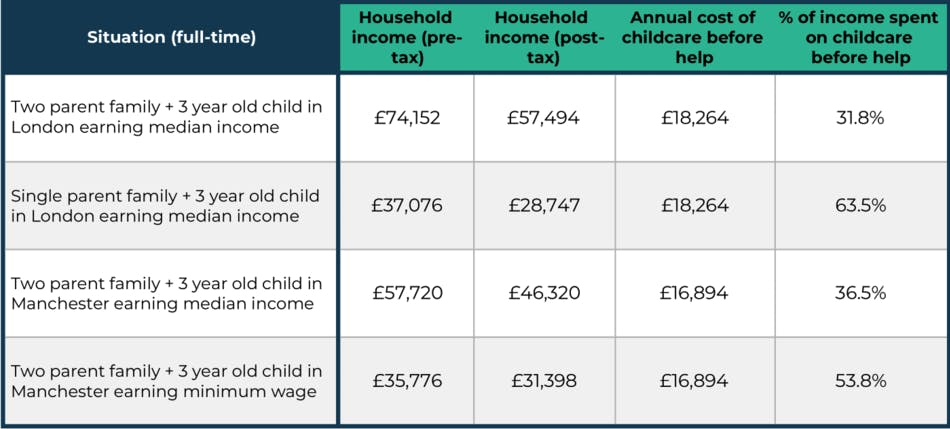
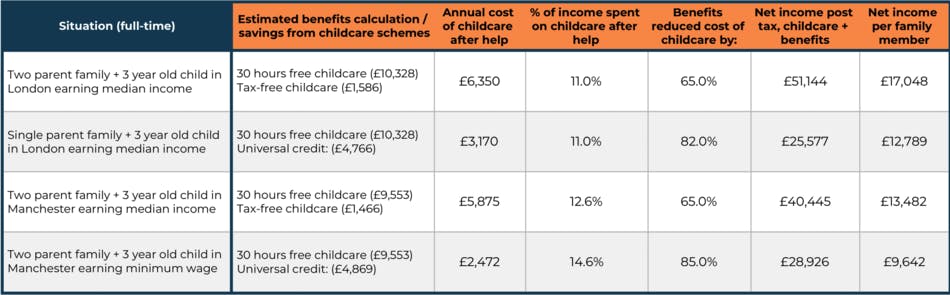
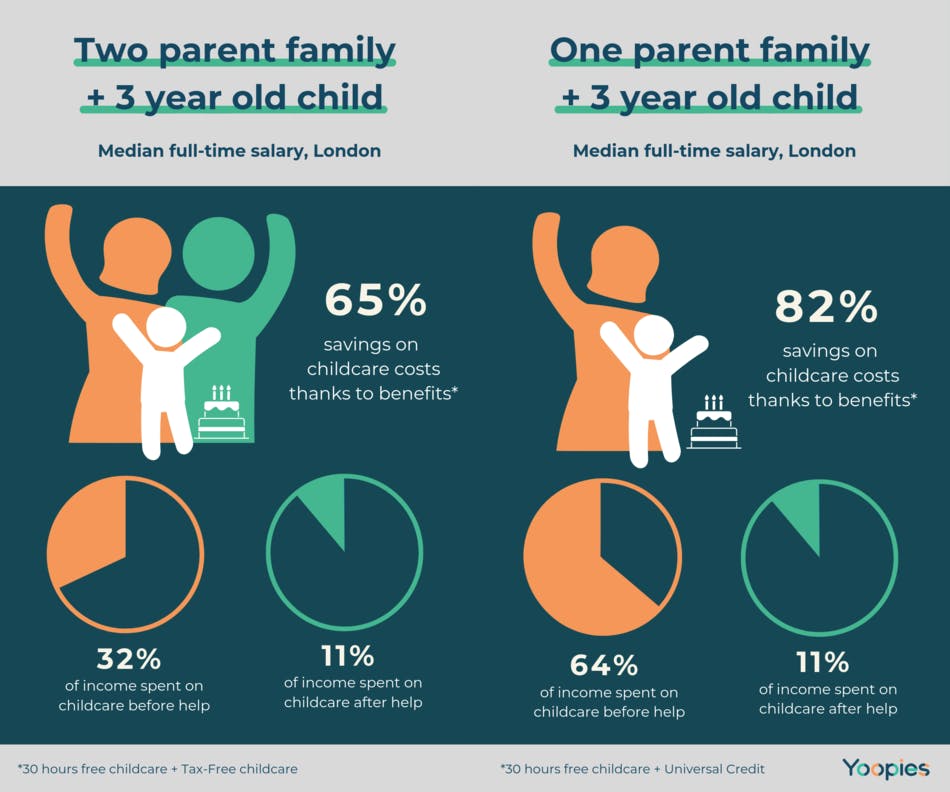
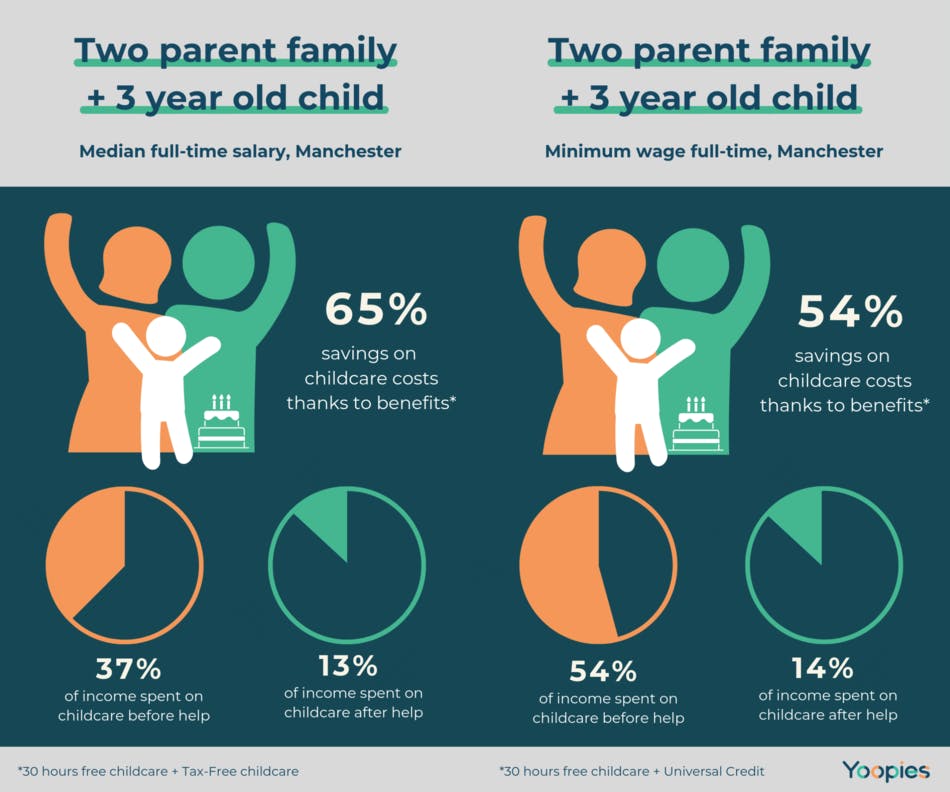
- While the price of childcare is higher in London than the rest of the UK, the average salary proportionally higher, meaning that families outside of London could expect to spend a higher percentage of their income on childcare
- Families in London and outside of London benefited from approximately the same amount of reduction in childcare costs thanks to the various financial assistance and childcare schemes. However, the average family outside of London would still end up paying proportionally more on childcare.
- Perhaps, it can be concluded that the childcare benefits system favours those families living in London and that a more granular regional approach should be taken when calculating benefit entitlements. It is important to consider, however, that other costs (rent, food, utilities etc.) are inflated in London in comparison to the rest of the country, and they may not necessarily be inflated in proportion with the increased income levels
- Parents claiming the 30 hours free childcare scheme can still expect to spend up to 15% of their income on childcare that would be needed outside of the free hours. It, therefore, brings into question whether 30 hours is sufficient
Families with a primary school aged child (5-12 years old) where all parents worked full-time
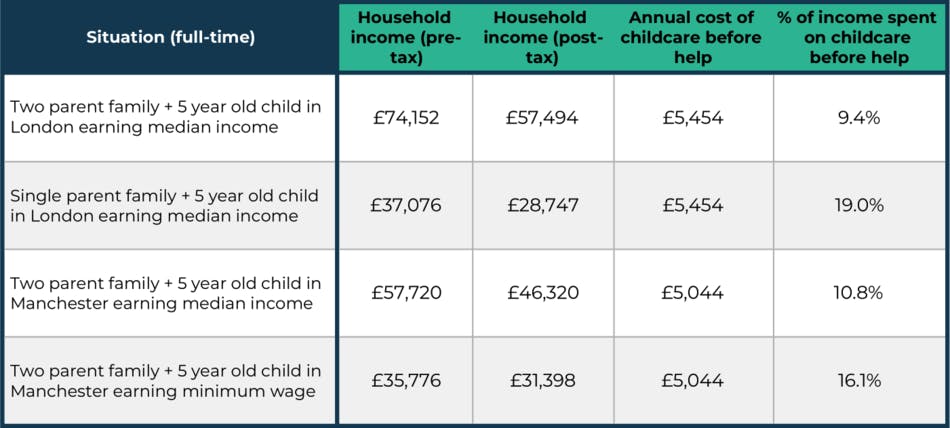
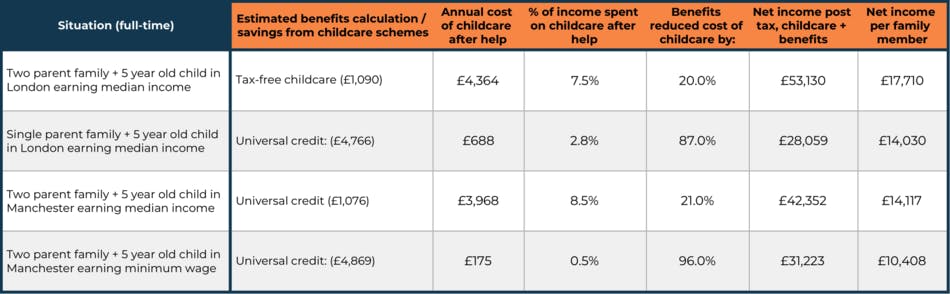
- The various childcare benefits schemes seem to help those who need it the most; however there were significant differences between middle-income and lower-income families in terms of the amount of money that could be saved
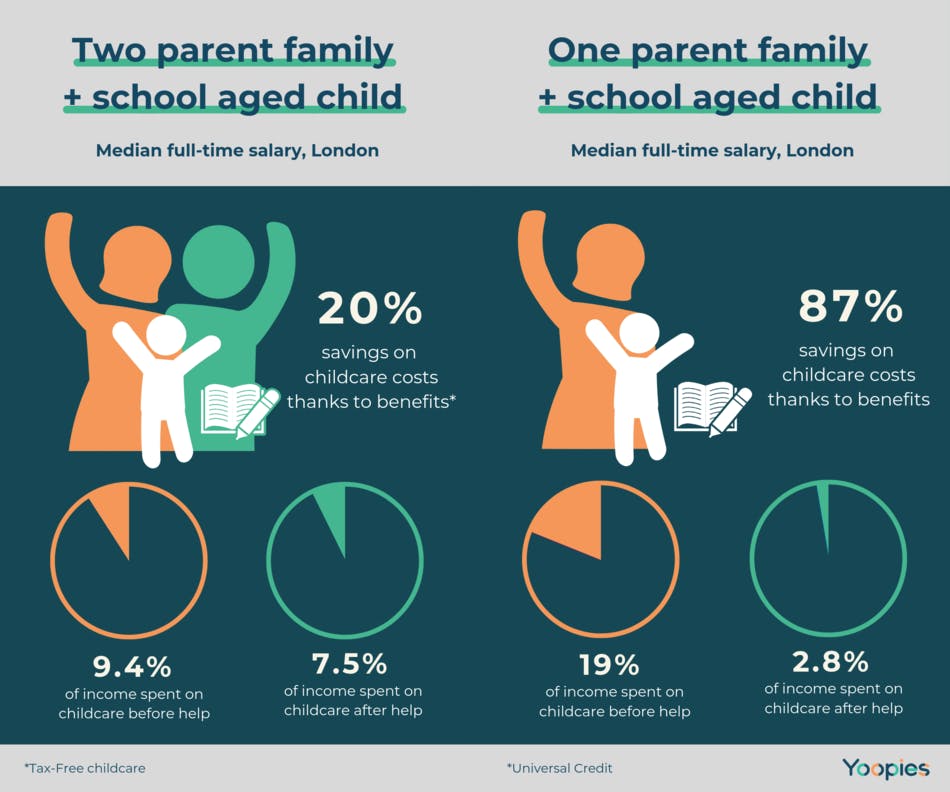
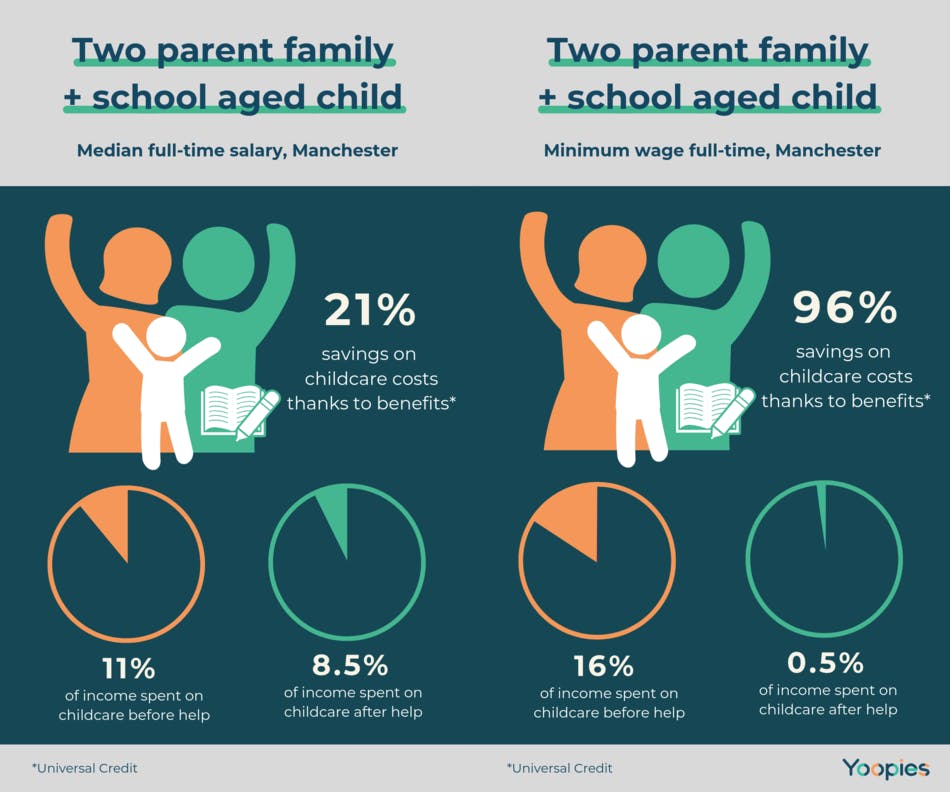
- Thanks to Universal Credit, a family working full-time on minimum wage could expect to see their out-of-school childcare costs essentially covered by benefits, whereas a single parent earning the median income for London would still need to pay some 3% of their income on childcare
- Middle-income families would be likely to only benefit from either Tax-Free Childcare or the Child Benefit portion of Universal Credit, and the exact savings would depend largely on how much the family would spend on childcare. If a middle-income family found themselves needing additional childcare to the estimates provided, it is more likely that they would be better off claiming Tax-Free Childcare rather than Universal Credit, as the allowance of the latter would only significantly increase if the family’s income was reduced for whatever reason
- Similarly to what was seen for a family with a pre-school aged child, a middle-income family in London could expect to pay proportionally less of their income on childcare both before and after Government-aided financial assistance
Families with a pre-school aged child (3-4 year old) where one parent worked part-time in order to avoid childcare costs
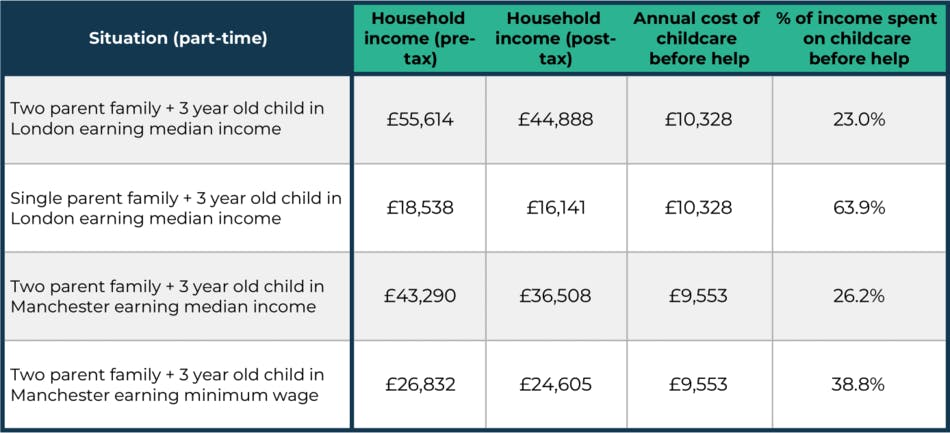
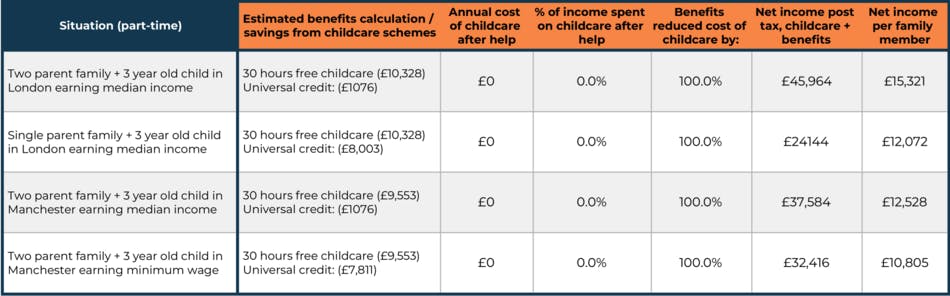
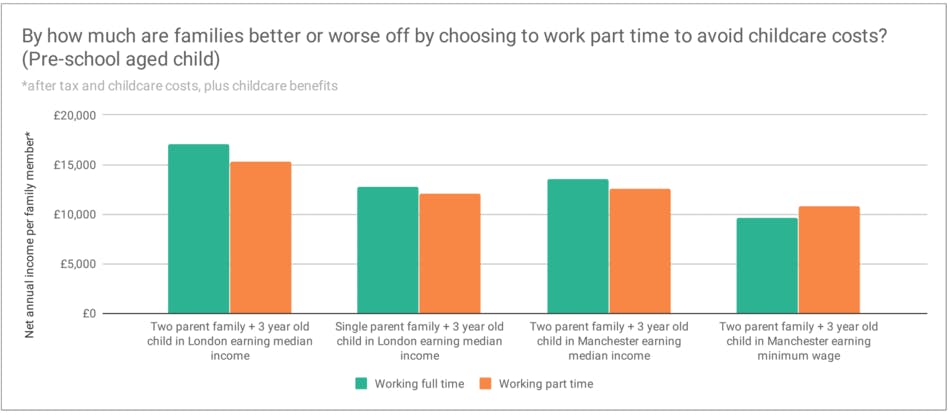
- Middle-income families would be unlikely to receive any additional Universal Credit allowance, even if one parent was to cut their working hours (and subsequently their salary) in half in order to avoid the use of formal childcare. For this reason, the household would be around £6,000 worse off each year than if both parents worked full time and took full advantage of the financial assistance available to them.
- A single parent family could see their Universal Credit allowances nearly doubling due to a reduction in working hours, however, if they earnt the median salary in London they would still be comparatively better off if they worked full time (by around £3,000 each year)
- A family earning minimum wage outside of London would also see their Universal Credit allowances double, however they might be slightly better off (by around £4,000 each year) if one parent chose to reduce their hours. This would be due to the fact that the average price of childcare is higher than the minimum wage, and because they would not be saving as much in income tax as a median-salary worker due to the way that tax-free allowances work.
- Middle-income families would not be eligible to claim tax-free childcare as they would have no childcare costs, however they would now be eligible for the Child Benefit portion of Universal Credit, which could be used to supplement the family’s reduced income.
Families with a primary school aged child (5-12 years old) where one parent worked part-time in order to avoid childcare costs
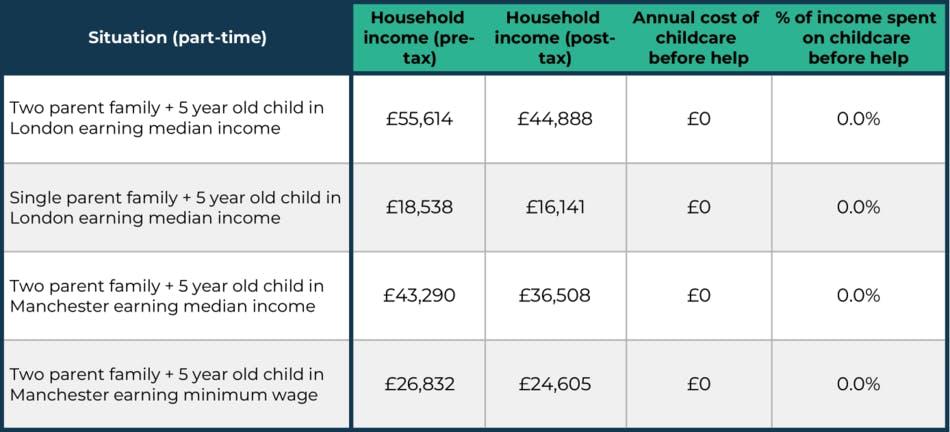
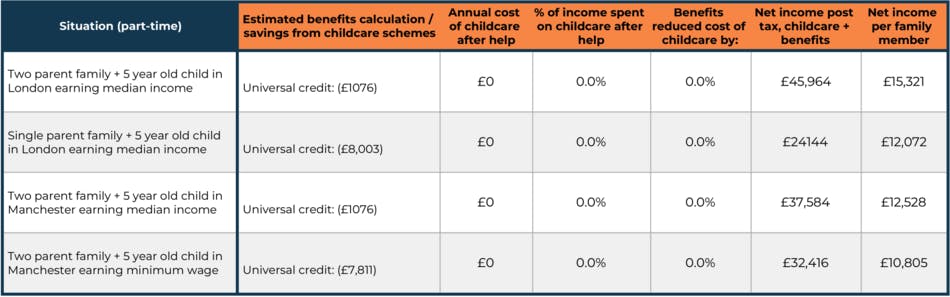
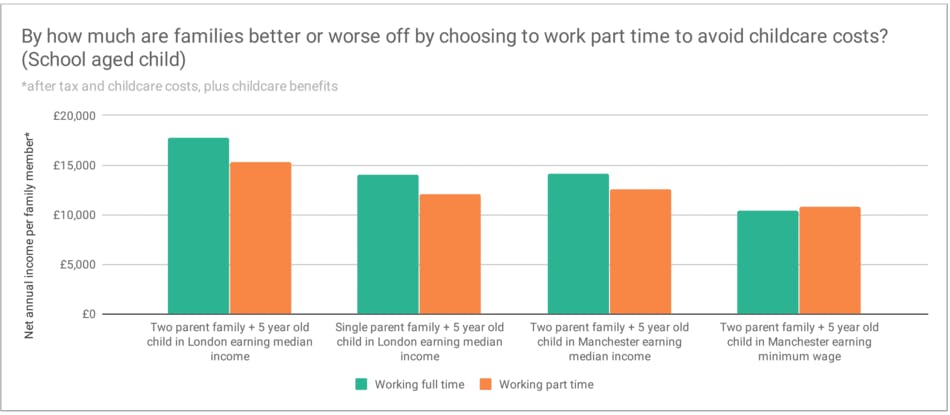
- The findings were more or less identical to families with a pre-school aged child, apart from the fact that all of the family types would end up being comparatively worse off by working part-time than by working full-time; two-parent middle-income families in London might expect to be £8,000 per year worse off by reducing their hours, and £5,000 per year worse off if they lived in Manchester, for example
Additional notes about the study
It’s important to consider that there are numerous non-financial benefits for the use of formal childcare settings, such as group childminders and nurseries, including allowing children to develop social skills, make new friends and improve their learning capacities, even if many parents might be hesitant to trust somebody else with their child or worry about their children picking up bad habits from others. Hence, costs are not the only driving factor behind a family’s choice to use or not use formal childcare, but it does influence the decision significantly.
In order to calculate our simulation, we used the following benefits calculators: Gov.uk Childcare Calculator and Turn2Us Benefits Calculator. The following childcare benefits and assistance schemes were taken into consideration:
- 15/30 hours free childcare scheme (although it was found that all families who passed through the simulation with a 3 year old child would be eligible for the full 30 hours of free childcare)
- Tax-free childcare scheme
- Child benefit portions of Universal Credit
It’s important that this analysis is only used as a general overview, as entitlements can change drastically depending on a family’s personal situation. We therefore advise all families who think they might be entitled to childcare benefits to complete their own simulation.
We made the following assumptions
- Full-time childcare needs would amount to approximately 2,016 hours per year for a child who was not of school age. This was based on an average full-time working week of 42 hours (2018, Eurostat) plus extra commuting time, minus a paid holiday entitlement per year of 28 days + 8 bank holidays or approximately 302 hours (2019, Gov.uk).
- Out-of-school childcare needs for full-time working families would amount to approximately 602 hours per year for a child who was of school age. This was based on the above estimate for full-time childcare minus the average number of school hours in attendance by a primary school aged child (35 hours per week for 38 weeks of the year) (2019, European Commission)
- For families where one parent reduced their hours in order to avoid childcare costs, it was assumed that one parent would be working 20 hours per week. This would allow a 3-year old child to use all 30 hours of free childcare per week, and eliminate the need for out-of-school childcare for a primary school aged child.
- Average cost of childcare on the Yoopies platform: £9.06 per hour in London and £8.38 per hour in Manchester (2019, Internal Data – Yoopies). These prices can vary according to individual providers and type of childcare.
- Household incomes were based on: the median salary in London being £37,076 per year, in Manchester being £28,860 per year and the national Minimum Wage being £8.19 per hour. (2018, Office for National Statistics)
- Households used all of their tax-free allowance of £12,500 for each parent
- The family has one child with no legal disabilities
- The family has no additional sources of income
- Families were private tenants and paid £1,400 per month for rent in London and £1,000 per month for rent in Manchester, paying the average rate of council tax for a postcode in the city centre.
- In a situation where families were eligible for either Tax-Free childcare or Universal Credit, which are unable to be claimed simultaneously, the benefit which provided more cost savings would be claimed
For more information, please contact Francesca Chong at francesca@yoopies.com