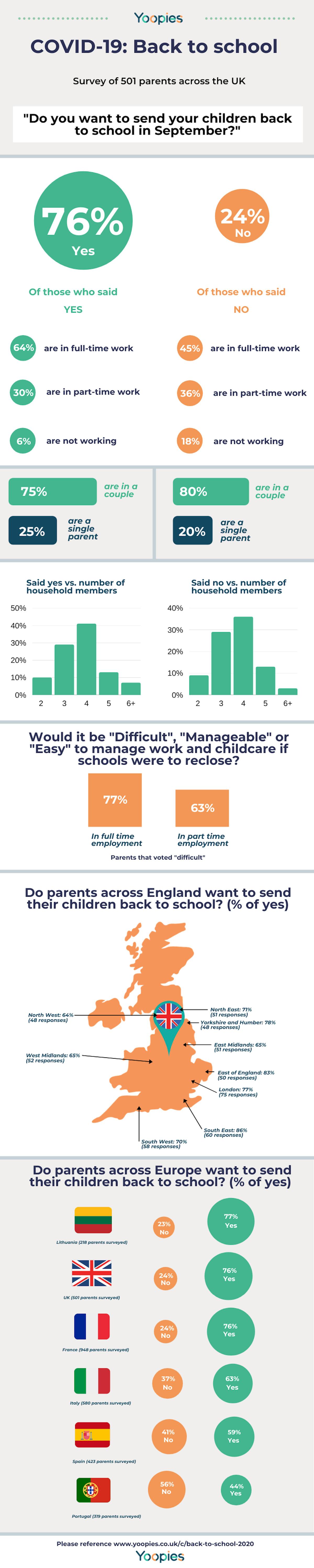
Despite uncertainty regarding the future of COVID-19, an increase of cases across Europe, as well as fears of a second wave in autumn, one thing is certain: most parents across Europe want to send their children back to school. Yoopies, Europe’s leading childcare provider has conducted a survey of over 3000 parents across the UK, France, Spain, Portugal, Italy, and Lithuania. The UK section of the survey concluded that 76% of British parents want to send their children back to school next week, and only less than a quarter do not.
UK is the least divided on schools opening
A Yoopies led study of European families asked whether parents wanted to send their children back in September. The percentage of parents who want to send their children back is as follows: Lithuania: 77%, UK: 76%, France: 76%, Italy: 63%, Spain 59%, Portugal: 44%. As European countries scramble to save their economies and get life back on track, it is unsurprising many parents support a return to school, despite a recent increase in cases.
In the UK specifically, over ¾ of parents surveyed want to send their children back in London, the East of England, the South East, and Yorkshire. The North West and West Midlands had the lowest percentage – 64% and 65% respectively. This regional disparity could be a product of local lockdowns experienced or scheduled.
Full-time parents are more likely to support Back to School
The Yoopies study on British parents showed a clear relationship between parents who want their children to return to school and their working hours. Of those who want to send their children back, 64% were in full-time work, 30% were in part-time work and 6% were unemployed. Contrastingly, of those who do not want to send their children back, 45% were in full-time work, 36% were in part-time work and 18% were unemployed. This suggests those in employment were collectively more in favour of sending their children back to school. Testimonies from parents evidence this trend, as one parent reported, “I need to work from home without the anxiety of home-schooling.” Another mirrors a similar view, “we work full time, we can not support our children at home in any meaningful manner.” The conclusion is clear: schools reopening are a lifeline for parents to continue working, and the economy depends on this.
In light of the difficulties of work-life balance that lockdown posed, having a childcare solution is essential to ensuring parents can work and prevent an economic collapse. 77% of parents in full-time employment admitted they would find it “difficult” to manage work and childcare should schools not be open. Across Europe, similar fears resonate. 64% of Italian parents feel they would not be able to stay at home with their children and in France, 63% of parents do not have a childcare solution in place should schools re-close.
“Socialising, routine and mental wellbeing”: key reasons to send children back
Many UK parents are already in agreement with the Government’s “national priority being all students returning […] for their education and wellbeing.” A reoccurring opinion among many parents surveyed is that the virus is less dangerous than the long term effects of missing school. One parent told us “it’s important to return to some form of normality, my children are bored at home, and not being at school has a detrimental effect on their development.” Another parent is in agreement, “children need to get back for their mental health, social skills and to get back on track academically.” It’s clear that parents are concerned that their children will miss out on key developmental milestones without school.
“Safety, second wave, and social distancing risk”: key reasons to keep children home
Despite Government efforts to ‘reassure every parent and pupil that schools are ready’, not all parents are in agreement. Nearly ¼ parents surveyed still want to keep their child at home. Main concerns included: not trusting school safety measures, worries of bringing the virus home, and fears of a second wave. One mother pointed out that “children are not going to be able to socially distance, they’ll be thankful to see their friends again and they’ll want that physical contact they’ve been lacking.” Another criticised the Government, saying “having a large number of people come together at the start of Autumn is asking for trouble.”
Parents aren’t the only ones with concerns, teachers unions are also calling for ‘greater clarity on what to do if there is a spike in cases,’. Francesca Chong, General Manager of Yoopies UK concluded: “To protect the economy, the Government should not only ensure a safe return to school in September but must publish a long term safety strategy with a clear back-up plan should schools re-close.”
Parent Testimonies:
“Yes” to sending children back to school:
- I feel the children need to get back to normality for their mental health and social skills but also to get back on track academically.
- My child is at nursery already and I have been very pleased with how they are maintaining distancing
- They are bored at home and missed out too much education
- With all safety measures and social distancing, it should be fine. We need to live our lives with Covid-19
- My child needs to be properly educated. I’m not a teacher.
- So my child is educated and learns more things than being at home
- for their emotional and educational wellbeing
- Because they have missed so much already.
- They have been out of school for nearly 7 months now and they miss their friends & need routine.
- Children are lonely, isolated, and missing out on crucial development and learning key skills. Parents are struggling!
- As my child needs to get back to a normal environment where she is interacting face-to-face with peers and she also needs to get back to an Academic Discipline. I also need to work in order to provide and therefore unable to leave her anywhere.
- The kids are going crazy, I’m going crazy, I think its time they go meet with their friends in the school
- Because kids need to be at school to learn and socialise. And I need to work without disruptions
- Because they should get back to normal life, do some studies, reading. They are missing what they need to do for their age and stop using gadgets.
- Routine. Mental well being. My sanity.
- The risks of spreading the virus associated with kids are very low,
- Nowhere is safe with this virus, but we have to try it and see how things go.
- They need social interaction with other kids. They need someone else to teach them other than me!
- I can’t home school and work – there aren’t enough hours on the day and I can’t replace their subject teachers. And nor can endless recordings and worksheets.
- I trust the school’s procedures.
- It is time we all start a “new normal”
- Very low risk, higher risk of lost education, although cases increased, death rates and hospitalizations have not.
- parents that work cannot provide anything close to school it’s important to begin to move towards some sense of normality.
- No school seems to be negatively affecting our child’s behavior
- Scientific evidence is a clear risk of transmission is low away from school for any longer will have not only a detrimental effect on their education and development but also their mental health and social schools.
- parents are no substitutes for and some children will have had no education of any description since the start of lockdown
- It is a dereliction of duty not too. Stats show children have the lowest risk by far – any teacher who needs to self isolate due to their own risk or a secondary illness that puts them in a COVID risk category should be allowed to Stay at home. Face coverings or a screen should be provided to teachers who are concerned. All children’s parents should fill in a consent form that fines them if they do not immediately self isolate if anyone in their family contracts COVID
- We work full time. We can not support our children at home in any meaningful manner. They are resentful and so are we.
- I need to work from home without the anxiety of homeschooling.
“No” to sending children back to school:
- I’m not sure it’s safe enough.
- Might potentially have a second wave. Children can be carriers of COVID-19.
- If they are told to social distance they’re not going to want to do that either because they’ll be thankful to see the majority of their friends again and they’ll want that physical contact that they’ve been lacking.
- Some parents don’t follow the guidelines which put other children and staff members at the school at risk
- Due to pandemic still, increase in cases
- Concerns about my kids being exposed to COVID and the increased spreading of the virus
- As there have been concerns about a second wave, I don’t feel that it’s safe to send kids into school
- Don’t trust safety measures
- Coronavirus restrictions will make it a less comforting and enjoyable environment – eg there won’t be any toys.
- Too risky
- I think there will be another spike in the coronavirus levels, and I think sending kids back to school will a) facilitate that spike and b) place those children and their families at higher risk of contracting the virus.
- don’t feel it’s worth the risk and would feel happier sending them back when it is safe.
- I think the teachers won’t be able to cope with trying to socially distance the kids and there is no regular testing.
- The set up is wrong. Would be better to half class sizes and go alternate weeks
- I think parents should be able to choose to continue home learning without the threat of fines.
- My daughter is asthmatic and has to take two trains to get to school. Coronavirus is still active and I’m terrified for her safety.
- Having a large group come together at the start of autumn is asking for trouble
- We are the legal guardians of our granddaughter and are in the vulnerable section.
- Children can become spreaders to the rest of the household
Lily Pryer
Head of UK Content, Communications and PR
+44 (0)20 3608 8269